Fiction · 1845
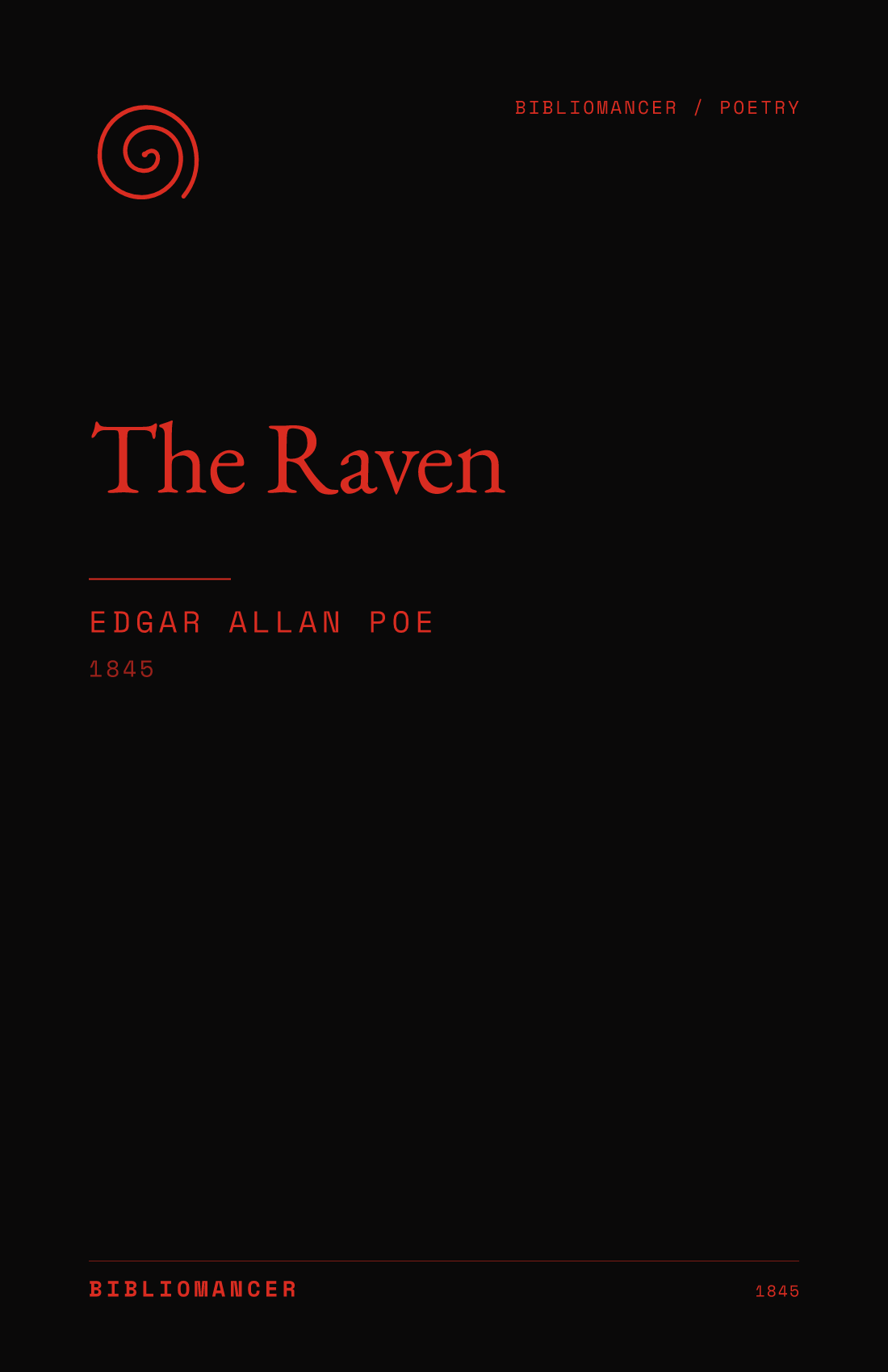
The Raven
The Raven, first published in 1845, has been pulled into the Bibliomancer archive: the complete text, carefully cleaned and typeset, free to read online. Its editorial introduction is still being prepared.
New editions
Never lose your place.
This book is free to read in full, and stays that way. Leave an address: one click confirms it and opens a free account, so your progress and bookmarks sync across every device. You'll also hear when the next restored edition enters the archive. Terminate at any time.
About this edition
The text is free of copyright. This edition was prepared from an authoritative digitisation, processed by Bibliomancer under its own review protocol; every automated correction is recorded in its transformation log. Rights assessed for CA, EU, GB, US.
Source mind
About the author
1809–1849 · Romantic
Edgar Allan Poe (1809–1849) was born in Boston to travelling actors who both died before he was three; raised in Richmond, Virginia by the merchant John Allan (whose name he took as his middle name but who never formally adopted him), he attended the University of Virginia and West Point before a permanent break with his foster father left him to support himself entirely by writing and editing, at a time when American magazines paid little and copyright piracy from Britain made a living wage still harder to earn. He worked as an editor for several Southern and Northern literary magazines, raising their circulation sharply through his own fiction, poetry, and notoriously exacting criticism, while publishing "The Fall of the House of Usher" (1839), "The Murders in the Rue Morgue" (1841, generally credited as the first modern detective story), and "The Raven" (1845), which made him a household name overnight but earned him only a few dollars. He married his young cousin Virginia Clemm in 1836; her long illness and death from tuberculosis in 1847 devastated him. He died in Baltimore at forty, in circumstances never fully explained, days after being found in distress on the street; his literary rival Rufus Griswold, appointed his literary executor, published a hostile obituary and memoir that shaped Poe's public image as a dissolute figure for decades afterward, notwithstanding Griswold's own fabrications.
Adjacent records