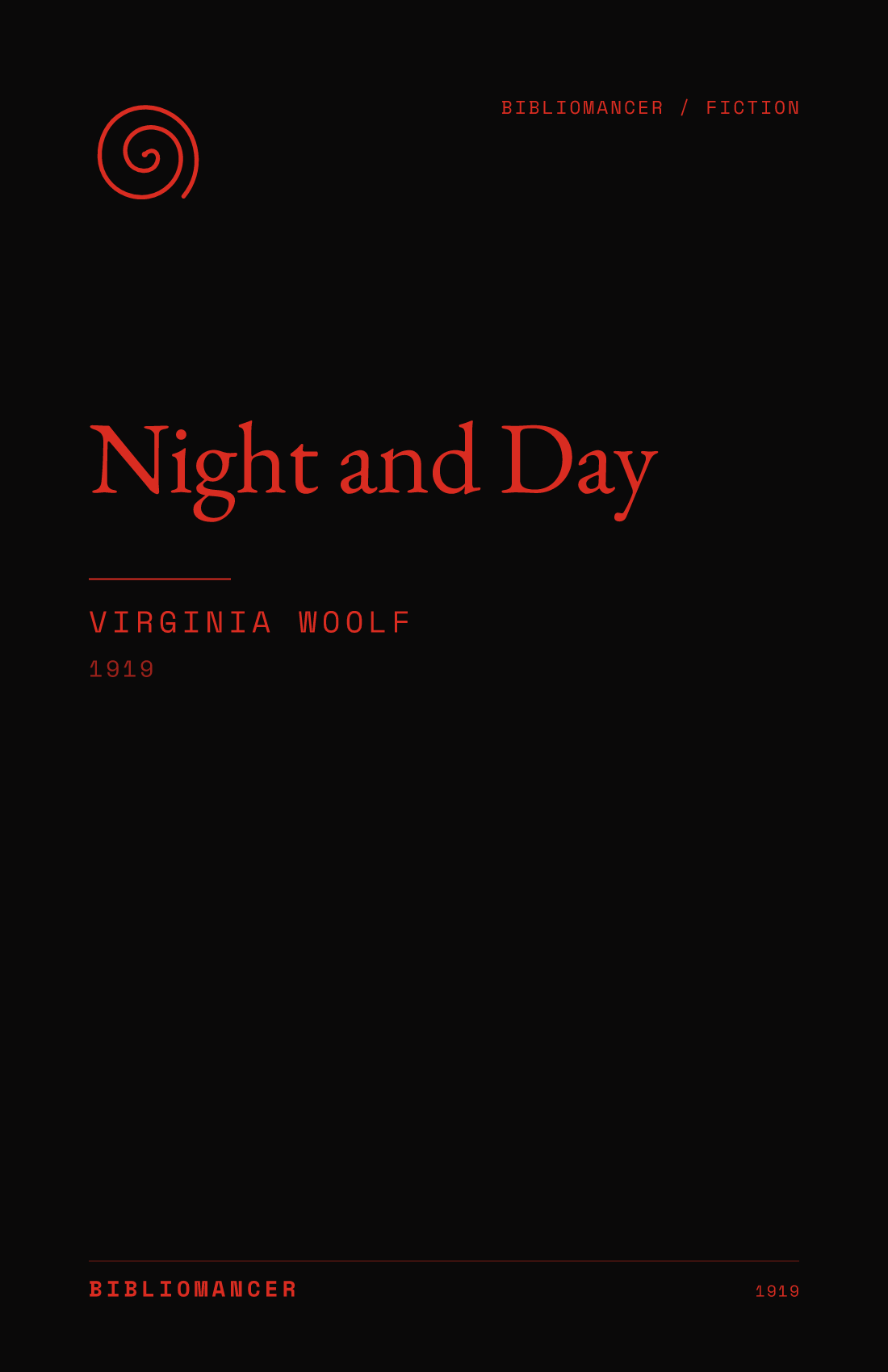
Fiction · 1919
Night and Day
Katharine Hilbery, granddaughter of a famous poet and long resigned to a practical, suitable engagement, finds her carefully arranged life pulled off course by Ralph Denham, a clerk of more feeling than fortune, while her friend Mary Datchet weighs her own quiet devotion to the suffrage cause against her feelings for the same man. Between them, the two women test what a woman of their generation is actually permitted to want — in love, and in work.
Virginia Woolf published Night and Day in 1919, her second novel and, by design, her most conventional: written in the realist manner of the previous generation rather than the fragmented, interior style she would make her own from Jacob's Room (1922) onward, it marks the deliberate last step before that break.
This Bibliomancer edition presents the complete text.
Contents
- Dedication
- Chapter I
- Chapter II
- Chapter III
- Chapter IV
- Chapter V
- Chapter VI
- Chapter VII
- Chapter VIII
- Chapter IX
- Chapter X
- Chapter XI
- Chapter XII
- Chapter XIII
- Chapter XIV
- Chapter XV
- Chapter XVI
- Chapter XVII
- Chapter XVIII
- Chapter XIX
- Chapter XX
- Chapter XXI
- Chapter XXII
- Chapter XXIII
- Chapter XXIV
- Chapter XXV
- Chapter XXVI
- Chapter XXVII
- Chapter XXVIII
- Chapter XXIX
- Chapter XXX
- Chapter XXXI
- Chapter XXXII
- Chapter XXXIII
- Chapter XXXIV
New editions
Never lose your place.
This book is free to read in full, and stays that way. Leave an address: one click confirms it and opens a free account, so your progress and bookmarks sync across every device. You'll also hear when the next restored edition enters the archive. Terminate at any time.
Subjects
About this edition
The text is free of copyright. This edition was prepared from an authoritative digitisation, processed by Bibliomancer under its own review protocol; every automated correction is recorded in its transformation log. Rights assessed for CA, EU, GB, US.
Source mind
About the author
1882–1941 · Modern
Virginia Woolf (1882–1941) was born Adeline Virginia Stephen in London, into a family already at the center of Victorian literary life — her father, Leslie Stephen, was the founding editor of the Dictionary of National Biography. After her father's death she and her siblings moved to Bloomsbury, where their circle of friends became known as the Bloomsbury Group. In 1912 she married Leonard Woolf; together they founded the Hogarth Press in 1917, which published her own novels — including Mrs. Dalloway (1925) and To the Lighthouse (1927) — alongside work by T. S. Eliot and Katherine Mansfield. Woolf struggled with recurring severe depression throughout her life and died by suicide in 1941, near her home in Sussex.
Adjacent records