Fiction · 1925
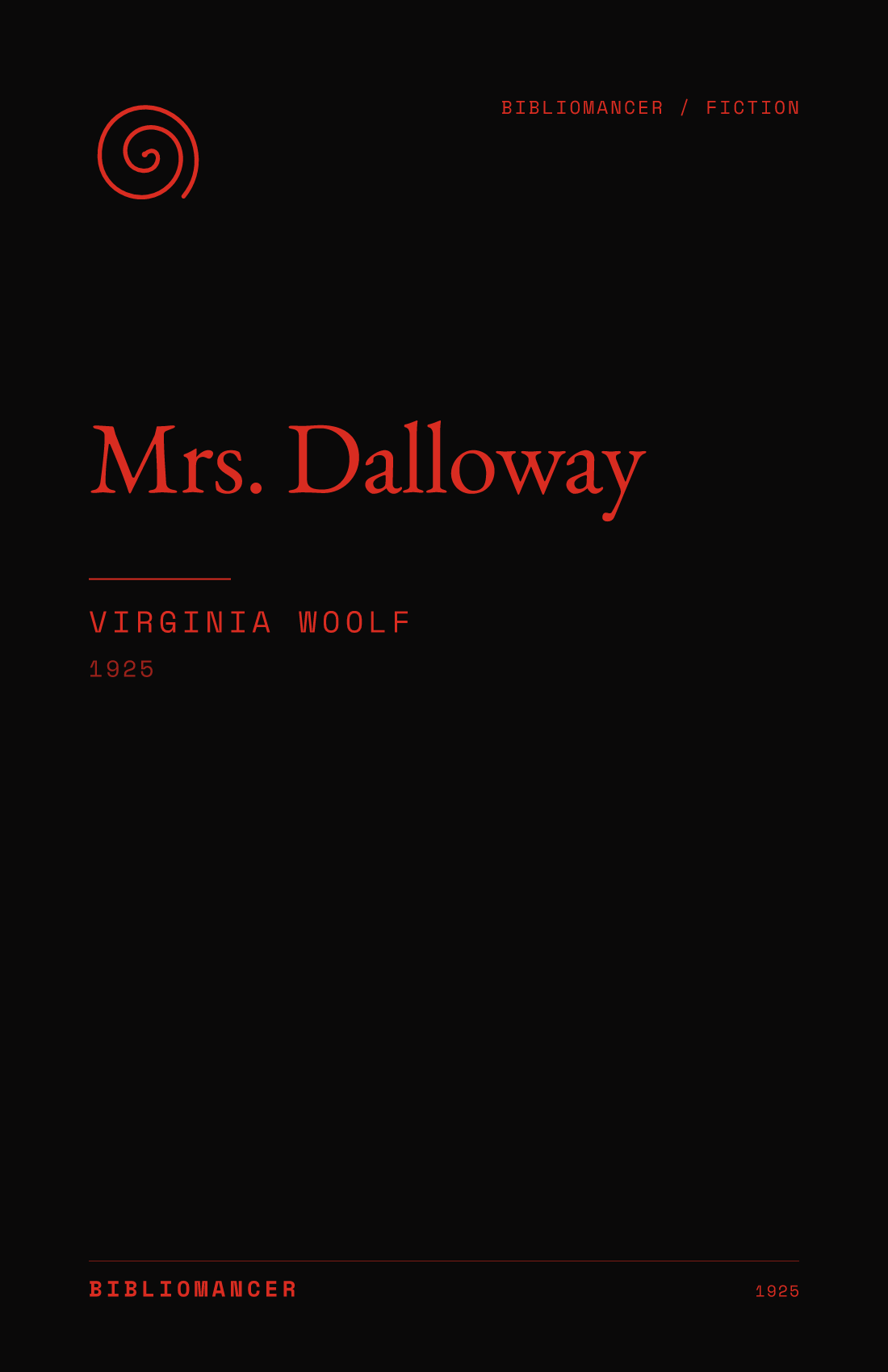
Mrs. Dalloway
Clarissa Dalloway decides to buy the flowers herself, and walks out into a June morning in London to do it. That is nearly the whole plot. The rest of the day — a party to give that evening, an old suitor turned up unannounced from India, a doctor's appointment across town for a young man named Septimus Warren Smith, whom she has never met and never will — happens alongside her, in the same hours, under the same striking of Big Ben, until the two lives that never touch turn out to be about the same thing.
Woolf published Mrs. Dalloway in 1925 through the Hogarth Press, and it is built on a technical wager: that a single ordinary day, followed closely enough and from inside enough heads, can hold as much as a plotted novel usually needs a decade for. There are no chapter breaks. The prose moves from one person's thoughts into another's without announcing the change, the way attention actually does, and the effect — intimate, slightly dizzying, exact — is why the book is still taught as one of the clearest demonstrations of what stream-of-consciousness narration can do.
Bibliomancer publishes the complete text, unbroken, exactly as Woolf set it down.
New editions
Never lose your place.
This book is free to read in full, and stays that way. Leave an address: one click confirms it and opens a free account, so your progress and bookmarks sync across every device. You'll also hear when the next restored edition enters the archive. Terminate at any time.
Subjects
About this edition
The text is free of copyright. This edition was prepared from an authoritative digitisation, processed by Bibliomancer under its own review protocol; every automated correction is recorded in its transformation log. Rights assessed for CA, EU, GB, US.
Source mind
About the author
1882–1941 · Modern
Virginia Woolf (1882–1941) was born Adeline Virginia Stephen in London, into a family already at the center of Victorian literary life — her father, Leslie Stephen, was the founding editor of the Dictionary of National Biography. After her father's death she and her siblings moved to Bloomsbury, where their circle of friends became known as the Bloomsbury Group. In 1912 she married Leonard Woolf; together they founded the Hogarth Press in 1917, which published her own novels — including Mrs. Dalloway (1925) and To the Lighthouse (1927) — alongside work by T. S. Eliot and Katherine Mansfield. Woolf struggled with recurring severe depression throughout her life and died by suicide in 1941, near her home in Sussex.
Adjacent records