Fiction · 1682
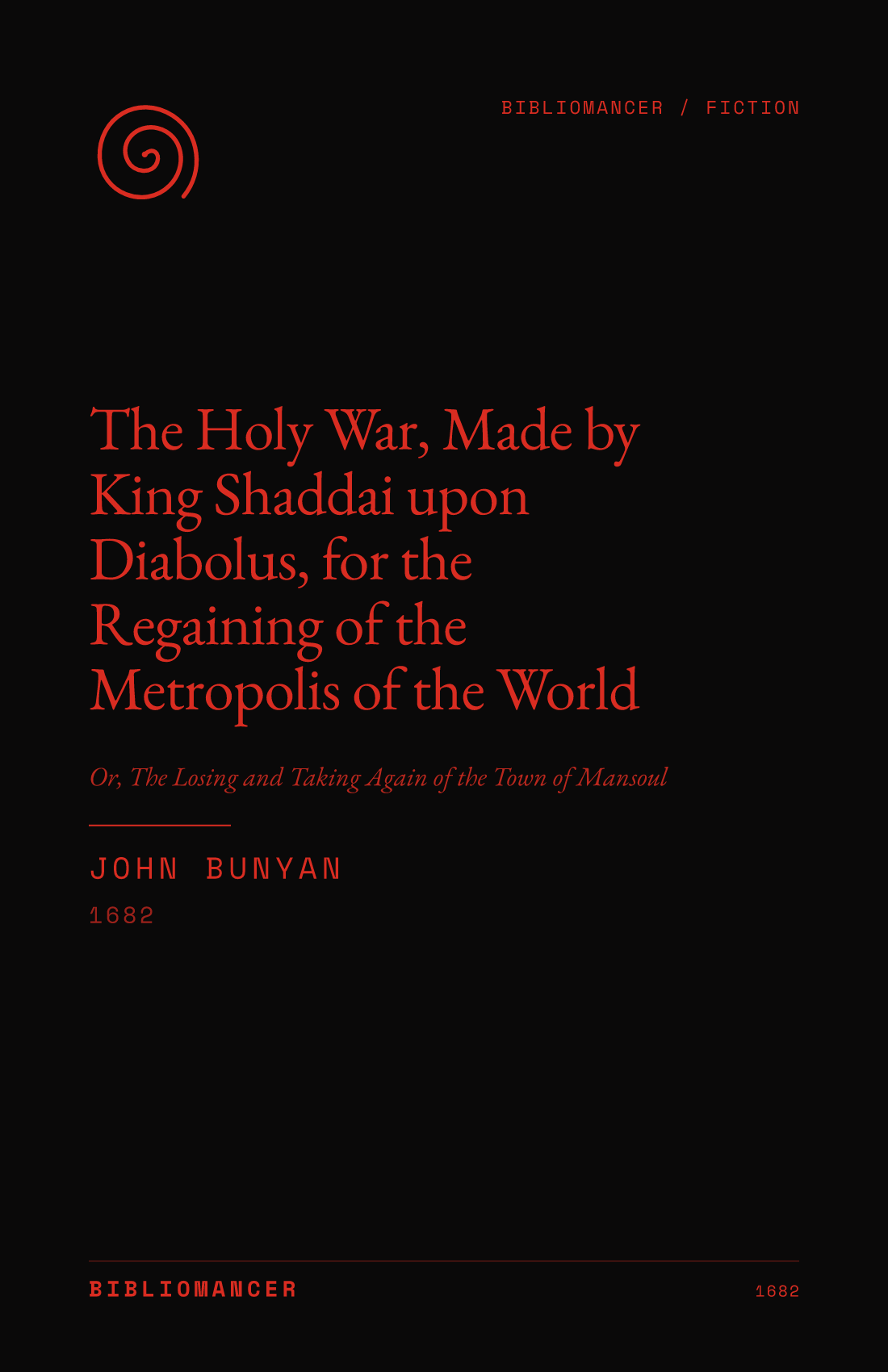
The Holy War, Made by King Shaddai upon Diabolus, for the Regaining of the Metropolis of the World
Or, The Losing and Taking Again of the Town of Mansoul
An allegory of spiritual warfare told as a siege: the town of Mansoul, built by King Shaddai for his own delight, is captured through the treachery of the giant Diabolus and held under his tyranny until Shaddai's son, Emmanuel, leads an army of captains — Boanerges, Conviction, Judgment, Execution — to besiege and retake it. The fighting doesn't end with Mansoul's liberation: Diabolus and his agents mount fresh plots from without, and the town's own citizens are tempted back into old loyalties from within, so the war continues in cycles, mirroring the daily, ongoing character of the struggle Bunyan means the reader to recognize as their own.
Published in 1682, four years after The Pilgrim's Progress, The Holy War was Bunyan's own follow-up to that book's success. Macaulay judged that, had The Pilgrim's Progress never been written, The Holy War would have stood as the greatest of religious allegories.
Contents
New editions
Never lose your place.
This book is free to read in full, and stays that way. Leave an address: one click confirms it and opens a free account, so your progress and bookmarks sync across every device. You'll also hear when the next restored edition enters the archive. Terminate at any time.
About this edition
The text is free of copyright. This edition was prepared from an authoritative digitisation, processed by Bibliomancer under its own review protocol; every automated correction is recorded in its transformation log. Rights assessed for CA, EU, GB, US.
Source mind
About the author
1628–1688 · 17th Century
John Bunyan (1628–1688) was born in Elstow, near Bedford, the son of a tinker, and served briefly in the Parliamentary army during the Civil War before returning home to take up his father's trade. He joined a nonconformist congregation in Bedford in 1653 and began preaching in 1657; after the Restoration made unlicensed preaching illegal, he was arrested in 1660 and spent some twelve years in Bedford gaol, refusing repeated offers of release in exchange for a promise to stop. He wrote Grace Abounding to the Chief of Sinners, his own spiritual autobiography, during this imprisonment, publishing it in 1666; a second, shorter spell in gaol in 1676–77 produced The Pilgrim's Progress (1678), the allegory of Christian's journey to the Celestial City that became one of the most widely read books in the English language. He died in London in 1688.
Adjacent records