Fiction · 1812
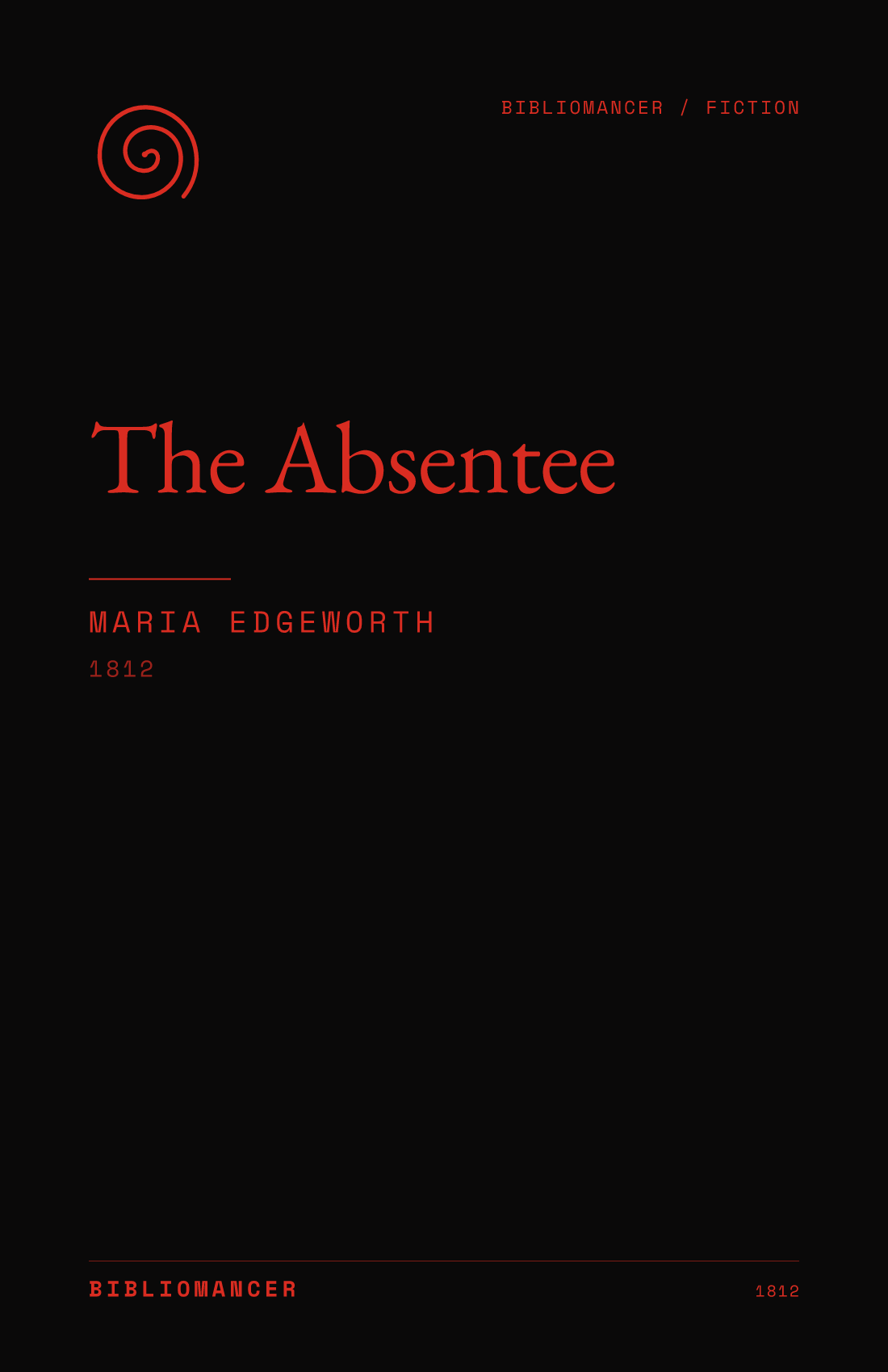
The Absentee
Lord and Lady Clonbrony have left their Irish estate to live in London, where Lady Clonbrony works at concealing her accent and her origins and is laughed at anyway, and the family spends what the property cannot produce. Their son, Lord Colambre, goes over to Ireland incognito to see the estate for himself, and travels it as a stranger: the tenants under a decent agent on one part, and under the Garraghtys on the other, where the rent is screwed out of them by a man who profits from every eviction. What he finds decides the question the book was written to put — whether a landlord has any business living anywhere but on his own land.
Maria Edgeworth published The Absentee in 1812, in the second series of her Tales of Fashionable Life. She had run her father's Irish estate herself, and the account of rent, middlemen and management is a practical one; the novel was read as an argument as much as a story.
This Bibliomancer edition presents the complete text.
Contents
New editions
Never lose your place.
This book is free to read in full, and stays that way. Leave an address: one click confirms it and opens a free account, so your progress and bookmarks sync across every device. You'll also hear when the next restored edition enters the archive. Terminate at any time.
Subjects
About this edition
The text is free of copyright. This edition was prepared from an authoritative digitisation, processed by Bibliomancer under its own review protocol; every automated correction is recorded in its transformation log. Rights assessed for CA, EU, GB, US.
Source mind
About the author
1768–1849 · Romantic
Maria Edgeworth (1768–1849) was born at Black Bourton, Oxfordshire, and in 1782 moved with her family to her father's estate at Edgeworthstown, County Longford, where she lived for the rest of her life and, in her later years, managed the land herself. Her father, the inventor and educational reformer Richard Lovell Edgeworth, was her closest collaborator; together they published the treatise Practical Education (1798) before she brought out Castle Rackrent anonymously in 1800, putting her name to it only with its second edition in 1811. Belinda (1801), The Absentee (1812), Patronage (1814) and further tales followed. Walter Scott credited her directly in his preface to Waverley (1814) with having shown him what might be done for Scotland, having herself "so fortunately achieved" it for Ireland. She never married, and died at Edgeworthstown.
Adjacent records