Nonfiction · 1792
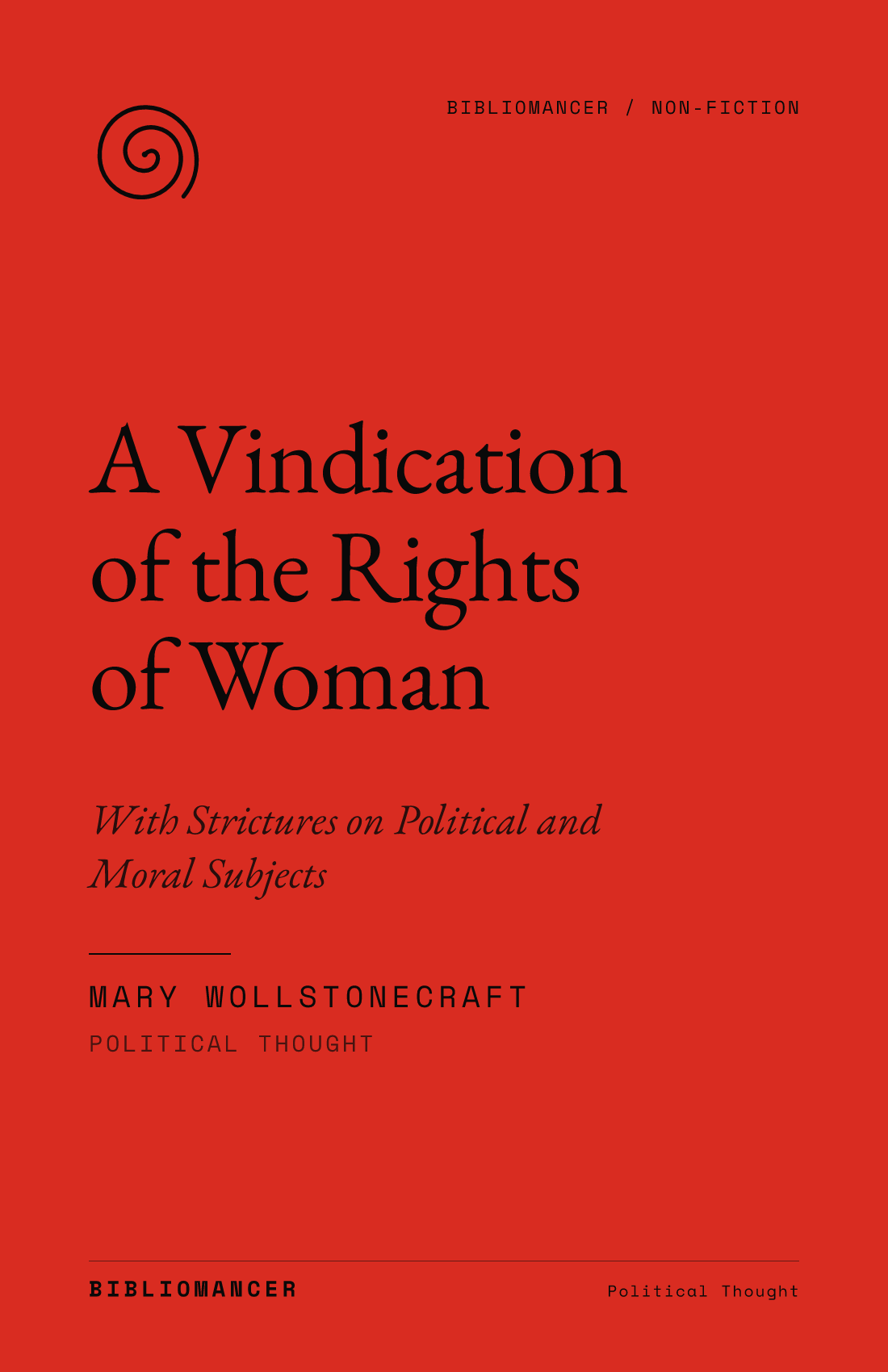
A Vindication of the Rights of Woman
With Strictures on Political and Moral Subjects
Mary Wollstonecraft’s book argues that women are not naturally inferior to men but appear so only because they are denied education, and that a society which keeps them ornamental and dependent corrupts both sexes. It is the founding text of modern feminism.
The argument is aimed at Rousseau and at the conduct books, and it is about education before it is about rights: a girl taught to please, dressed for display and kept from anything difficult will grow into exactly the creature men then point to as proof. Wollstonecraft wanted day schools open to both sexes, a profession for any woman who wanted one, and marriage understood as friendship rather than as a market.
Written in a few months and published in 1792, the book carries her dedication to Talleyrand, who had just laid a plan for French national education before the Assembly and left girls out of it.
Contents
- To M. Talleyrand Perigord, Late Bishop of Autun
- Introduction
- Chapter 1 — The Rights and Involved Duties of Mankind Considered
- Chapter 2 — The Prevailing Opinion of a Sexual Character Discussed
- Chapter 3 — The Same Subject Continued
- Chapter 4 — Observations on the State of Degradation to Which Woman Is Reduced by Various Causes
- Chapter 5 — Animadversions on Some of the Writers Who Have Rendered Women Objects of Pity, Bordering on Contempt
- Chapter 6 — The Effect Which an Early Association of Ideas Has Upon the Character
- Chapter 7 — Modesty Comprehensively Considered and Not as a Sexual Virtue
- Chapter 8 — Morality Undermined by Sexual Notions of the Importance of a Good Reputation
- Chapter 9 — Of the Pernicious Effects Which Arise from the Unnatural Distinctions Established in Society
- Chapter 10 — Parental Affection
- Chapter 11 — Duty to Parents
- Chapter 12 — On National Education
- Chapter 13
New editions
Never lose your place.
This book is free to read in full, and stays that way. Leave an address: one click confirms it and opens a free account, so your progress and bookmarks sync across every device. You'll also hear when the next restored edition enters the archive. Terminate at any time.
Subjects
About this edition
The text is free of copyright. This edition was prepared from an authoritative digitisation, processed by Bibliomancer under its own review protocol; every automated correction is recorded in its transformation log. Rights assessed for CA, EU, GB, US.
Part of Political Thought.
Source mind
About the author
1759–1797 · Enlightenment
Mary Wollstonecraft (1759–1797) kept a school, worked as a governess, and from 1787 supported herself by writing in London, where she belonged to the radical circle of her publisher Joseph Johnson. A Vindication of the Rights of Men (1790) answered Burke; A Vindication of the Rights of Woman (1792) made her name across Europe. She lived in Paris during the Revolution, married William Godwin in 1797 and died days after the birth of their daughter, Mary Shelley.
Adjacent records