Nonfiction · 416
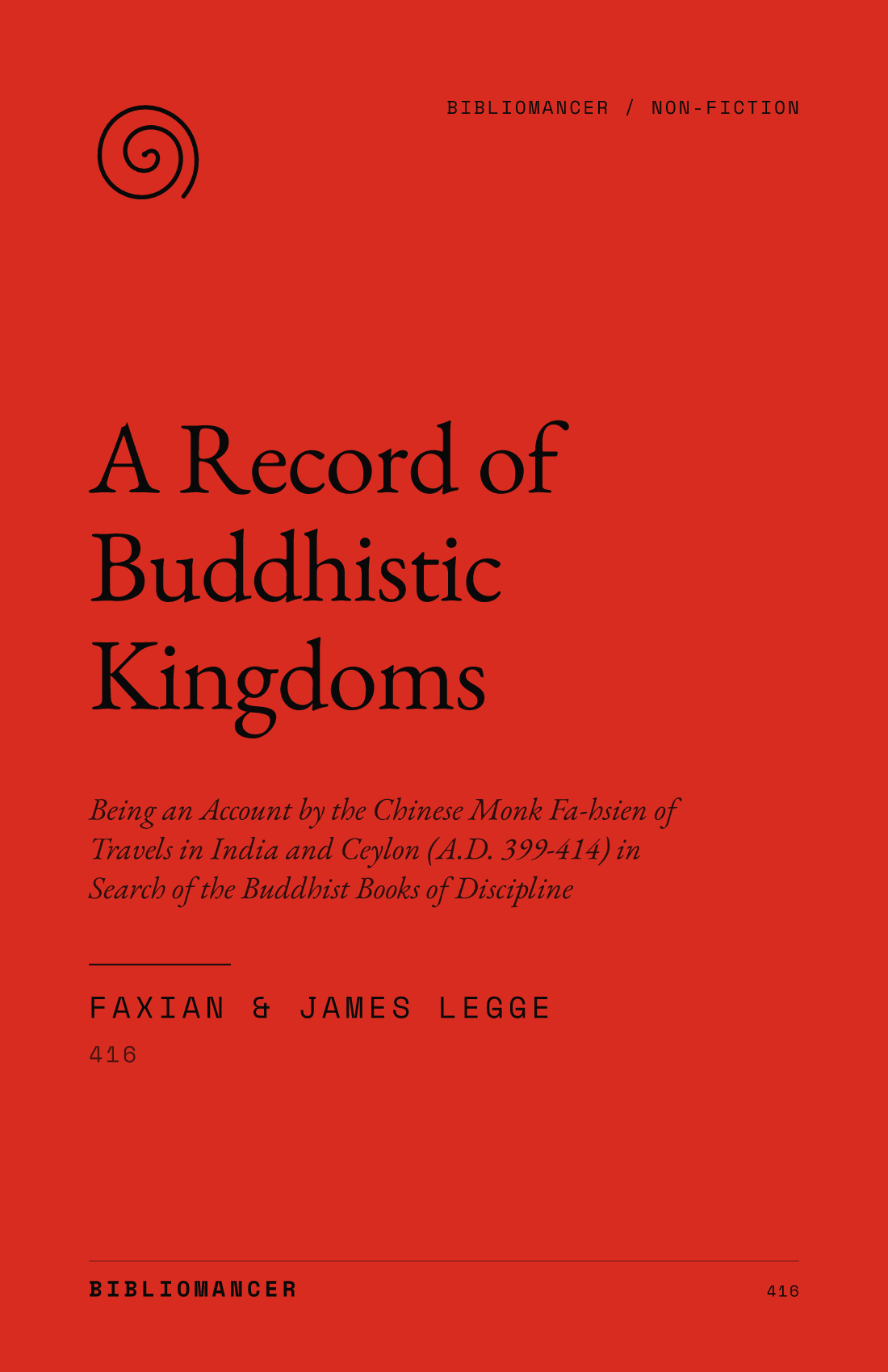
A Record of Buddhistic Kingdoms
Being an Account by the Chinese Monk Fa-hsien of Travels in India and Ceylon (A.D. 399-414) in Search of the Buddhist Books of Discipline
Faxian · translated by James Legge
In 399 the Chinese monk Faxian set out from Chang'an on foot, crossed the Gobi — where, he notes, the only markers are the bones of those who went before — and the Pamirs, spent years in India copying the monastic rules that China lacked, went on to Ceylon, and came home by sea in 414 after a voyage that nearly killed him twice. This is his own account: the kingdoms he passed through, the state of the Buddhist communities in each, the relics and the festivals, the sites of the Buddha's life as pilgrims then knew them, and the practical business of travelling ten thousand miles to fetch a book.
Faxian's record is one of the earliest first-hand descriptions of India by a foreign visitor and a primary source for the period. This edition is James Legge's English translation, published in 1886 with his introduction and notes.
This Bibliomancer edition presents the complete text.
Contents
- Introductory
- Introduction
- Chapter I — From Ch’ang-Gan to the Sandy Desert
- Notes
- Chapter II — On to Shen-Shen and Thence to Khoten
- Notes
- Chapter III — Khoten. Processions of Images. The King’s New Monastery
- Notes
- Chapter IV — Through the Ts’ung or “Onion” Mountains to K’eeh-Ch’a;—Probably Skardo, or Some City More to the East in Ladak
- Notes
- Chapter V — Great Quinquennial Assembly of Monks. Relics of Buddha. Productions of the Country
- Notes
- Chapter VI — On Towards North India. Darada. Image of Maitreya Bodhisattva
- Notes
- Chapter VII — Crossing of the Indus. When Buddhism First Crossed the River for the East
- Notes
- Chapter VIII — Woo-Chang, or Udyana. Monasteries, and Their Ways. Traces of Buddha
- Notes
- Chapter IX — Soo-Ho-To. Legend of Buddha
- Notes
- Chapter X — Gandhara. Legends of Buddha
- Notes
- Chapter XI — Takshasila. Legends. The Four Great Topes
- Notes
- Chapter XII — Purushapura, or Peshawur. Prophecy About King Kanishka and His Tope. Buddha’s Alms-Bowl. Death of Hwuy-Ying
- Notes
- Chapter XIII — Nagara. Festival of Buddha’s Skull-Bone. Other Relics, and His Shadow
- Notes
- Chapter XIV — Death of Hwuy-King in the Little Snowy Mountains. Lo-E. Pohna. Crossing the Indus to the East
- Notes
- Chapter XV — Bhida. Sympathy of Monks with the Pilgrims
- Notes
- Chapter XVI — On to Mathura or Muttra. Condition and Customs of Central India; Of the Monks, Viharas, and Monasteries
- Notes
- Chapter XVII — Sankasya. Buddha’s Ascent to and Descent from the Trayastrimsas Heaven, and Other Legends
- Notes
- Chapter XVIII — Kanyakubja, or Canouge. Buddha’s Preaching
- Notes
- Chapter XIX — Sha-Che. Legend of Buddha’s Danta-Kashtha
- Notes
- Chapter XX — Kosala and Sravasti. The Jetavana Vihara and Other Memorials and Legends of Buddha. Sympathy of the Monks with the Pilgrims
- Notes
- Chapter XXI — The Three Predecessors of Sakyamuni in the Buddhaship
- Notes
- Chapter XXII — Kapilavastu. Its Desolation. Legends of Buddha’s Birth, and Other Incidents in Connexion with It
- Notes
- Chapter XXIII — Rama, and Its Tope
- Notes
- Chapter XXIV — Where Buddha Finally Renounced the World, and Where He Died
- Notes
- Chapter XXV — Vaisali. The Tope Called “Weapons Laid Down.” the Council of Vaisali
- Notes
- Chapter XXVI — Remarkable Death of Ananda
- Notes
- Chapter XXVII — Pataliputtra or Patna, in Magadha. King Asoka’s Spirit-Built Palace and Halls. The Buddhist Brahman, Radha-Sami. Dispensaries and Hospitals
- Notes
- Chapter XXVIII — Rajagriha, New and Old. Legends and Incidents Connected with It
- Notes
- Chapter XXIX — Gridhra-Kuta Hill, and Legends. Fâ-Hien Passes a Night on It. His Reflections
- Notes
- Chapter XXX — The Srataparna Cave, or Cave of the First Council. Legends. Suicide of a Bhikshu
- Notes
- Chapter XXXI — Gaya. Sakyamuni’s Attaining to the Buddhaship; And Other Legends
- Notes
- Chapter XXXII — Legend of King Asoka in a Former Birth, and His Naraka
- Notes
- Chapter XXXIII — Mount Gurupada, Where Kasyapa Buddha’s Entire Skeleton Is
- Notes
- Chapter XXXIV — On the Way Back to Patna. Varanasi, or Benares. Sakyamuni’s First Doings After Becoming Buddha
- Notes
- Chapter XXXV — Dakshina, and the Pigeon Monastery
- Notes
- Chapter XXXVI — In Patna. Fâ-Hien’s Labours in Transcription of Manuscripts, and Indian Studies for Three Years
- Notes
- Chapter XXXVII — To Champa and Tamalipti. Stay and Labours There for Three Years. Takes Ship to Singhala, or Ceylon
- Notes
- Chapter XXXVIII — At Ceylon. Rise of the Kingdom. Feats of Buddha. Topes and Monasteries. Statue of Buddha in Jade. Bo Tree. Festival of Buddha’s Tooth
- Notes
- Chapter XXXIX — Cremation of an Arhat. Sermon of a Devotee
- Notes
- Chapter XL — After Two Years Takes Ship for China. Disastrous Passage to Java; And Thence to China; Arrives at Shan-Tung; And Goes to Nanking. Conclusion or L’Envoi by Another Writer
- Notes
New editions
Never lose your place.
This book is free to read in full, and stays that way. Leave an address: one click confirms it and opens a free account, so your progress and bookmarks sync across every device. You'll also hear when the next restored edition enters the archive. Terminate at any time.
Subjects
About this edition
The text is free of copyright. This edition was prepared from an authoritative digitisation, processed by Bibliomancer under its own review protocol; every automated correction is recorded in its transformation log. Rights assessed for CA, EU, GB, US.
Source mind
About the author
Adjacent records