Nonfiction · 1863
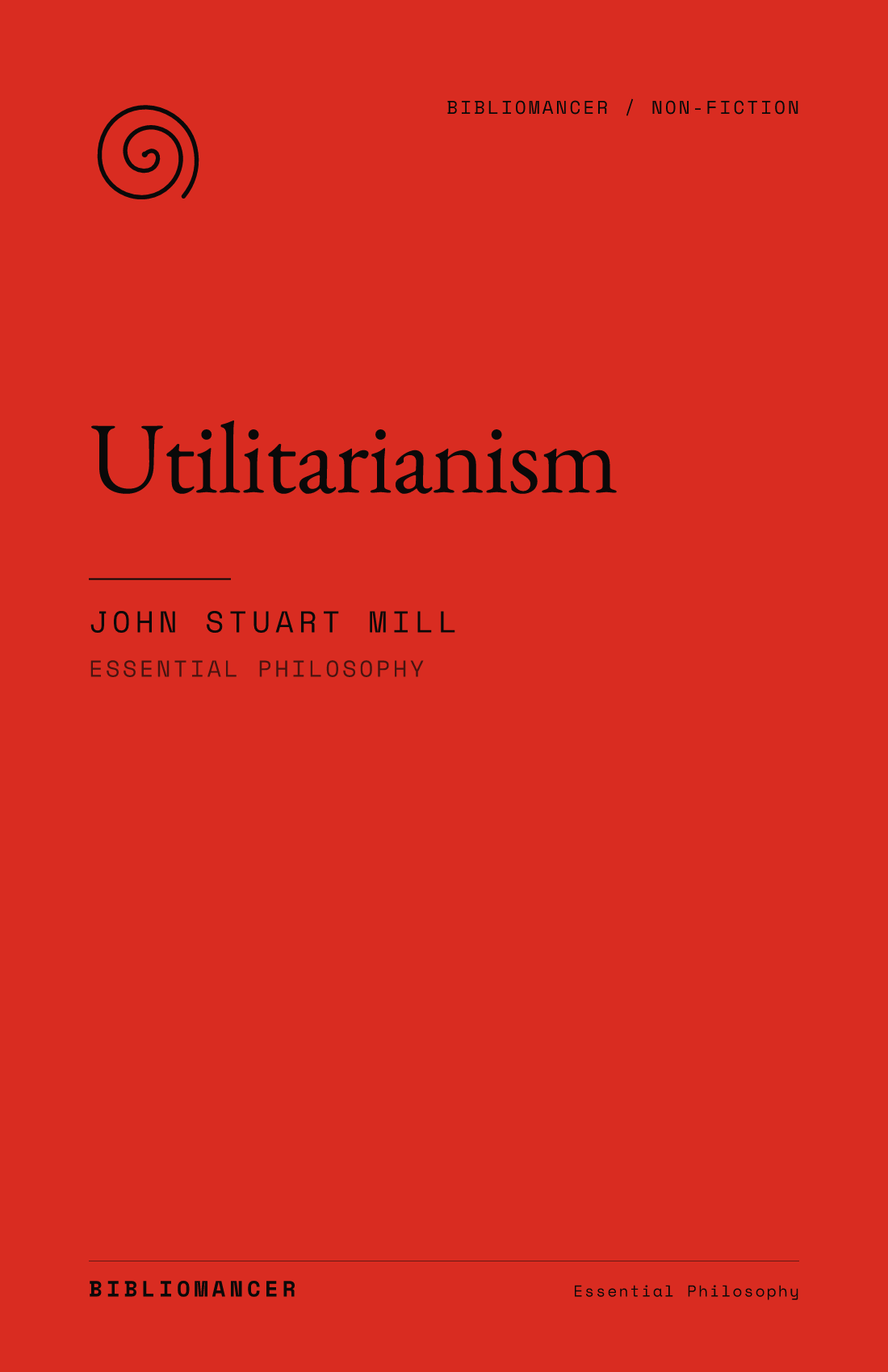
Utilitarianism
John Stuart Mill’s short defence of the principle that actions are right in proportion as they tend to promote happiness remains the classic statement of utilitarian ethics, and the one most argued with.
Mill’s difficulty is that the principle, stated baldly, invites the charge that it is a doctrine fit only for swine, and much of the book is spent answering it. He distinguishes higher pleasures from lower and rests the distinction on the judgement of those who have known both; he takes up the objections that utilitarianism is godless, that it leaves no time to calculate, and that it cannot account for justice — the last of which occupies the whole of the fifth chapter.
First published in Fraser’s Magazine in 1861 and as a book in 1863, it is given here complete in its five chapters.
Contents
New editions
Never lose your place.
This book is free to read in full, and stays that way. Leave an address: one click confirms it and opens a free account, so your progress and bookmarks sync across every device. You'll also hear when the next restored edition enters the archive. Terminate at any time.
Subjects
About this edition
The text is free of copyright. This edition was prepared from an authoritative digitisation, processed by Bibliomancer under its own review protocol; every automated correction is recorded in its transformation log. Rights assessed for CA, EU, GB, US.
Part of Essential Philosophy.
Source mind
About the author
1806–1873 · Victorian
John Stuart Mill (1806–1873) was educated at home by his father, the philosopher James Mill, in a famously rigorous programme, and worked for the East India Company for thirty-five years while writing the System of Logic (1843), Principles of Political Economy (1848), On Liberty (1859), Utilitarianism (1861) and The Subjection of Women (1869). His collaborator in much of this was Harriet Taylor, whom he married in 1851. He sat in Parliament from 1865 to 1868 and died at Avignon.
Adjacent records