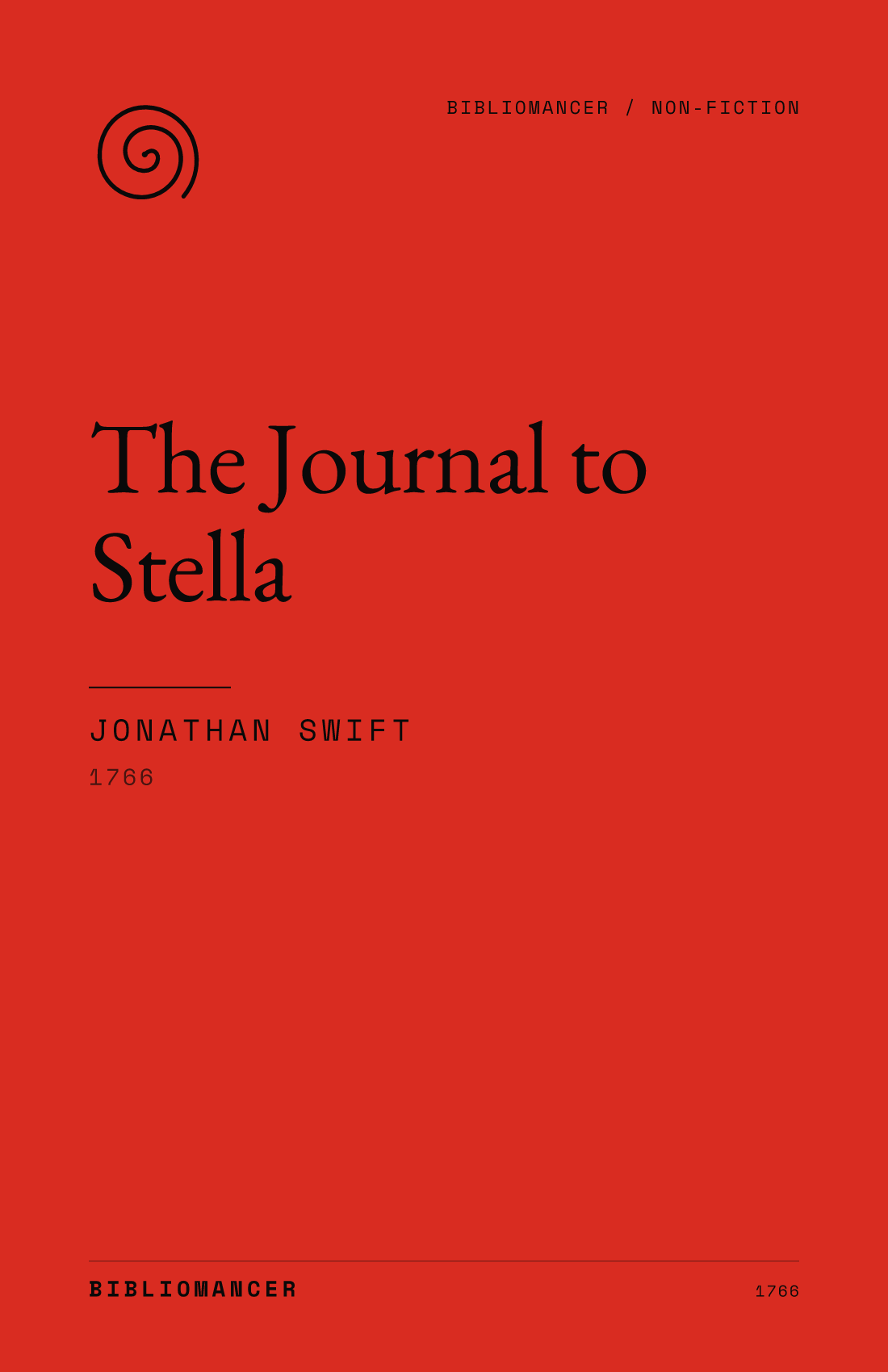
Nonfiction · 1766
The Journal to Stella
The Journal to Stella, first published in 1766, has been pulled into the Bibliomancer archive: the complete text, carefully cleaned and typeset, free to read online. Its editorial introduction is still being prepared.
Contents
- Preface
- Introduction
- Letter I
- Letter II
- Letter III
- Letter IV
- Letter V
- Letter VI
- Letter VII
- Letter VIII
- Letter IX
- Letter X
- Letter XI
- Letter XII
- Letter XIII
- Letter XIV
- Letter XV
- Letter XVI
- Letter XVII
- Letter XVIII
- Letter XIX
- Letter XX
- Letter XXI
- Letter XXII
- Letter XXIII
- Letter XXIV
- Letter XXV
- Letter XXVI
- Letter XXVII
- Letter XXVIII
- Letter XXIX
- Letter XXX
- Letter XXXI
- Letter XXXII
- Letter XXXIII
- Letter XXXIV
- Letter XXXV
- Letter XXXVI
- Letter XXXVII
- Letter XXXVIII
- Letter XXXIX
- Letter XL
- Letter XLI
- Letter XLII
- Letter XLIII
- Letter XLIV
- Letter XLV
- Letter XLVI
- Letter XLVII
- Letter XLVIII
- Letter XLIX
- Letter L
- Letter LI
- Letter LII
- Letter LIII
- Letter LIV
- Letter LV
- Letter LVI
- Letter LVII
- Letter LVIII
- Letter LIX
- Letter LX
- Letter LXI
- Letter LXII
- Letter LXIII
- Letter LXIV
- Letter LXV
- Footnotes
New editions
Never lose your place.
This book is free to read in full, and stays that way. Leave an address: one click confirms it and opens a free account, so your progress and bookmarks sync across every device. You'll also hear when the next restored edition enters the archive. Terminate at any time.
Subjects
About this edition
The text is free of copyright. This edition was prepared from an authoritative digitisation, processed by Bibliomancer under its own review protocol; every automated correction is recorded in its transformation log. Rights assessed for CA, EU, GB, US.
Source mind
About the author
1667–1745 · Enlightenment
Jonathan Swift (1667–1745) was born in Dublin, educated at Trinity College, and ordained in the Church of Ireland; he was secretary to Sir William Temple in England, a Tory pamphleteer in London, and from 1713 Dean of St Patrick’s Cathedral, Dublin. A Tale of a Tub (1704), the Drapier’s Letters (1724), Gulliver’s Travels (1726) and A Modest Proposal (1729) are the best known of his works, most of which he published anonymously.
Adjacent records