Fiction · 1911
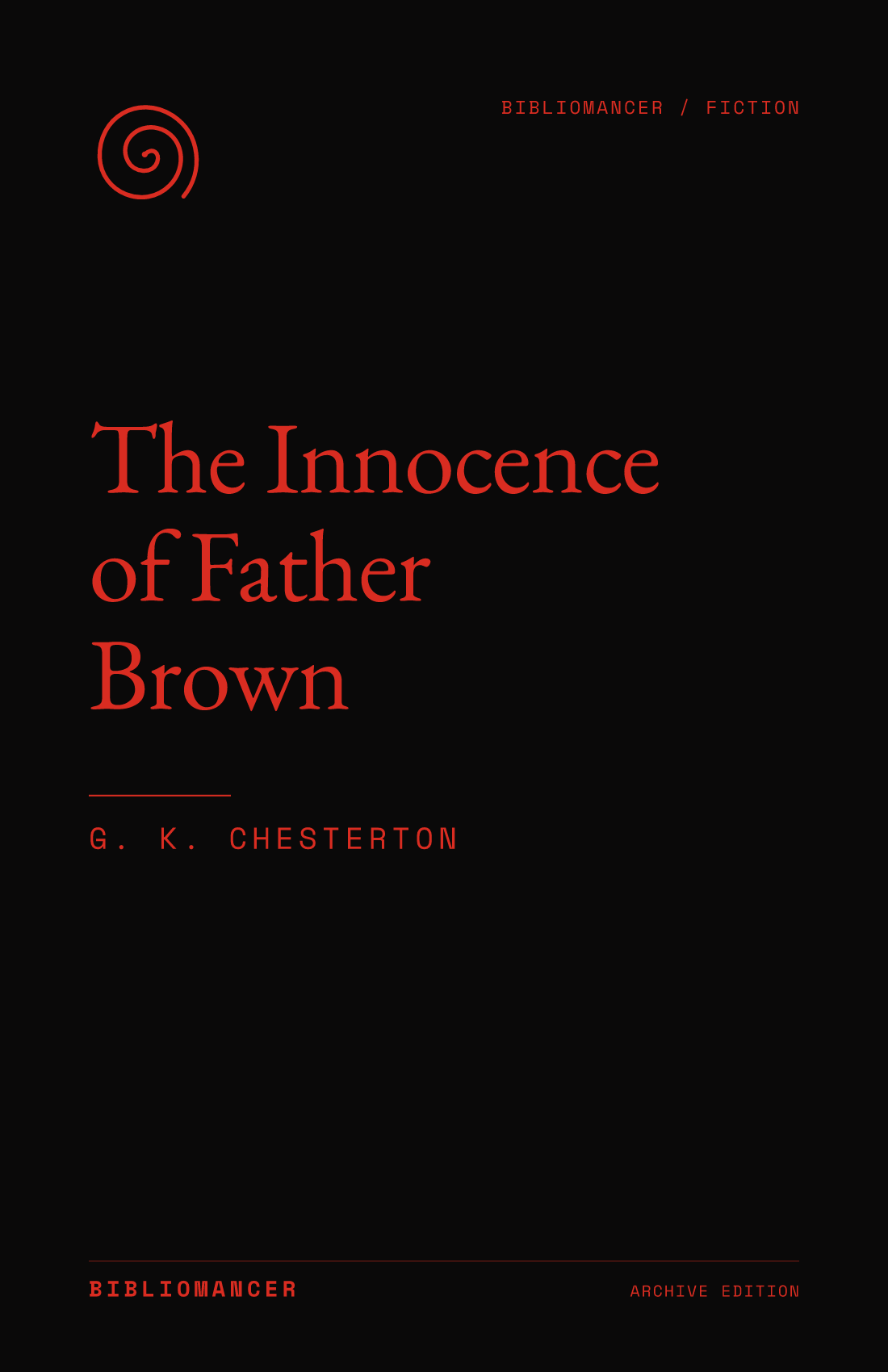
The Innocence of Father Brown
The Innocence of Father Brown, first published in 1911, has been pulled into the Bibliomancer archive: the complete text, carefully cleaned and typeset, free to read online. Its editorial introduction is still being prepared.
Contents
New editions
Never lose your place.
This book is free to read in full, and stays that way. Leave an address: one click confirms it and opens a free account, so your progress and bookmarks sync across every device. You'll also hear when the next restored edition enters the archive. Terminate at any time.
Subjects
About this edition
The text is free of copyright. This edition was prepared from an authoritative digitisation, processed by Bibliomancer under its own review protocol; every automated correction is recorded in its transformation log. Rights assessed for CA, EU, GB, US.
Source mind
About the author
1874–1936 · Modern
G. K. Chesterton (1874–1936) was born in Kensington, London, and worked most of his life as a journalist and essayist, writing for the Daily News and the Illustrated London News. A big man — six foot four, known for his cape, crumpled hat and swordstick — he made his name with the essay collections Heretics (1905) and Orthodoxy (1908) and the novel The Man Who Was Thursday (1908), then created the detective-priest Father Brown in The Innocence of Father Brown (1911) and The Wisdom of Father Brown (1914). He converted to Roman Catholicism in 1922 and died in Beaconsfield, Buckinghamshire, in 1936.
Adjacent records