Nonfiction · 1848
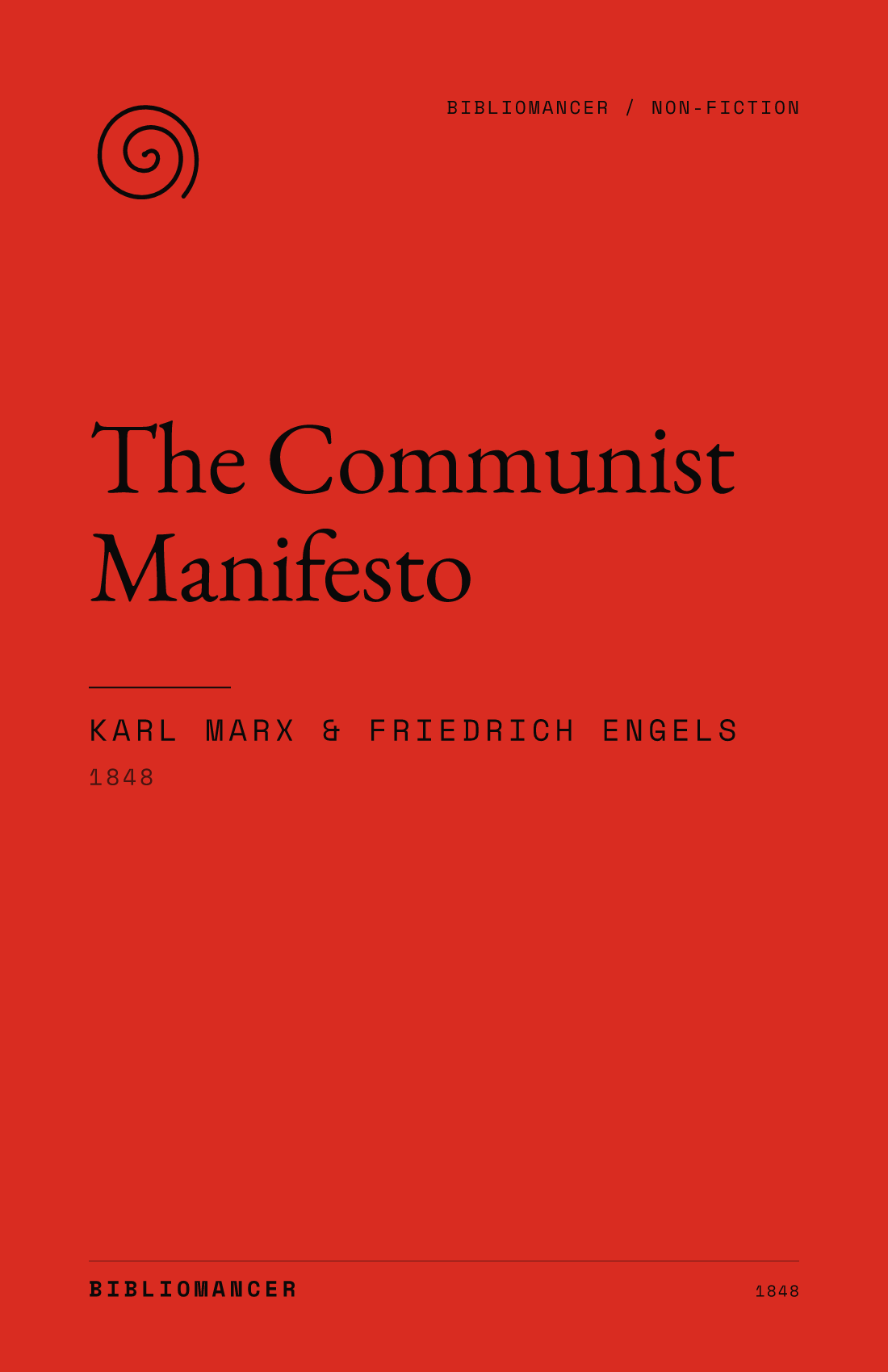
The Communist Manifesto
Karl Marx, Friedrich Engels · translated by Samuel Moore
The Communist Manifesto, first published in 1848, has been pulled into the Bibliomancer archive: the complete text, carefully cleaned and typeset, free to read online. Its editorial introduction is still being prepared.
Contents
New editions
Never lose your place.
This book is free to read in full, and stays that way. Leave an address: one click confirms it and opens a free account, so your progress and bookmarks sync across every device. You'll also hear when the next restored edition enters the archive. Terminate at any time.
About this edition
The text is free of copyright. This edition was prepared from an authoritative digitisation, processed by Bibliomancer under its own review protocol; every automated correction is recorded in its transformation log. Rights assessed for CA, EU, GB, US.
Source minds
About the authors
1818–1883 · Victorian
Karl Marx (1818–1883) was born in Trier, in the Prussian Rhineland, to a family of Jewish descent that had converted to Lutheranism, and studied law and then philosophy at Bonn and Berlin. Expelled from Prussia, Paris, and Belgium in turn for his radical journalism, he settled in London in 1849 and spent the rest of his life there, chiefly supported by his collaborator Friedrich Engels, researching and writing in the British Museum's reading room. With Engels he wrote The Communist Manifesto (1848); alone, he produced the first volume of Capital (1867), a critique of political economy left unfinished at his death, with two further volumes edited from his manuscripts by Engels. He is buried in Highgate Cemetery, London.
1820–1895 · Victorian
Friedrich Engels (1820–1895) was born in Barmen, in the Prussian Rhineland, the son of a textile manufacturer, and sent to work in the family's Manchester cotton-milling business, where what he saw of industrial poverty shaped The Condition of the Working Class in England (1845). He met Karl Marx in 1844 and became his lifelong collaborator and, after 1850, his financial support, co-writing The Communist Manifesto (1848) with him and afterward editing the second and third volumes of Capital from Marx's manuscripts after Marx's death. He also wrote Anti-Dühring (1878) and The Origin of the Family, Private Property and the State (1884). He died in London.
Adjacent records