Nonfiction · 1891
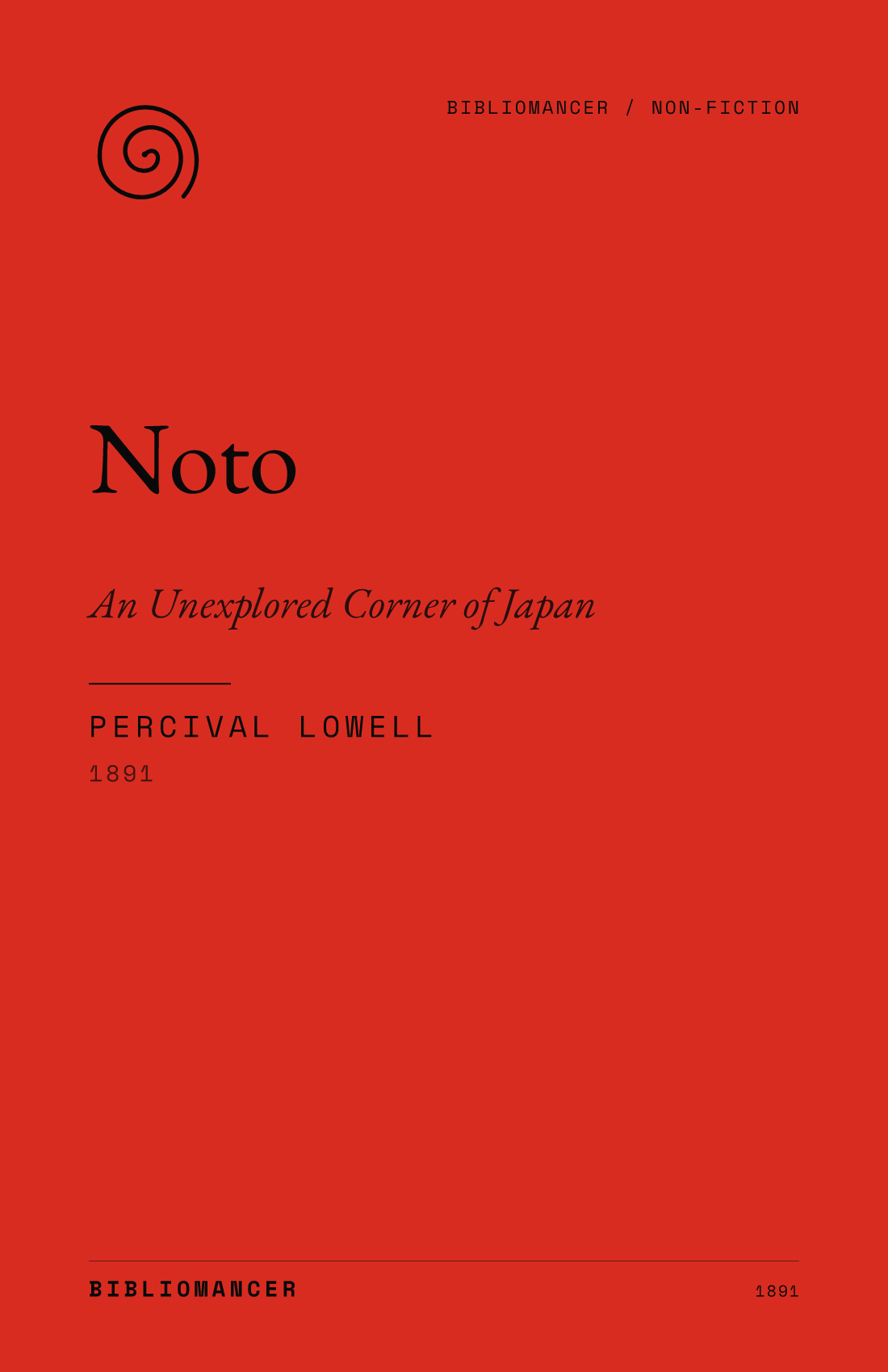
Noto
An Unexplored Corner of Japan
Noto, first published in 1891, has been pulled into the Bibliomancer archive: the complete text, carefully cleaned and typeset, free to read online. Its editorial introduction is still being prepared.
Contents
- Epigraph
- I — An Unknown
- II — Off and On
- III — The Usui Pass
- IV — Zenkoji
- V — No
- VI — On a New Cornice Road
- VII — Oya Shiradzu, Ko Shiradzu
- VIII — Across the Etchiu Delta
- IX — Over the Arayama Pass
- X — An Inland Sea
- XI — Anamidzu
- XII — At Sea Again
- XIII — On the Noto Highway
- XIV — The Harinoki Toge
- XV — Toward the Pass
- XVI — Riuzanjita
- XVII — Over the Snow
- XVIII — A Genial Inkyo
- XIX — Our Passport and the Basha
- XX — Down the Tenriugawa
- XXI — To the Sea
New editions
Never lose your place.
This book is free to read in full, and stays that way. Leave an address: one click confirms it and opens a free account, so your progress and bookmarks sync across every device. You'll also hear when the next restored edition enters the archive. Terminate at any time.
About this edition
The text is free of copyright. This edition was prepared from an authoritative digitisation, processed by Bibliomancer under its own review protocol; every automated correction is recorded in its transformation log. Rights assessed for CA, EU, GB, US.
Source mind
About the author
1855–1916 · Victorian
Percival Lowell (1855–1916) was born in Cambridge, Massachusetts, into the prominent Lowell family — his siblings included the Harvard president A. Lawrence Lowell and the poet Amy Lowell — and graduated from Harvard in 1876 with distinction in mathematics. From 1883 he spent roughly a decade largely travelling in East Asia, serving at one point as foreign secretary and counselor to the first Korean diplomatic mission to the United States, and wrote three books on Japan and Korea, including The Soul of the Far East (1888). Turning to astronomy in his late thirties, he founded the Lowell Observatory in Flagstaff, Arizona, in 1894 to study Mars, whose apparent "canals" he championed, controversially, as evidence of intelligent life. His calculations from irregularities in Uranus's orbit predicted an undiscovered planet beyond Neptune; the search he set in motion found Pluto in 1930, fourteen years after his death.
Adjacent records