Nonfiction · 1912
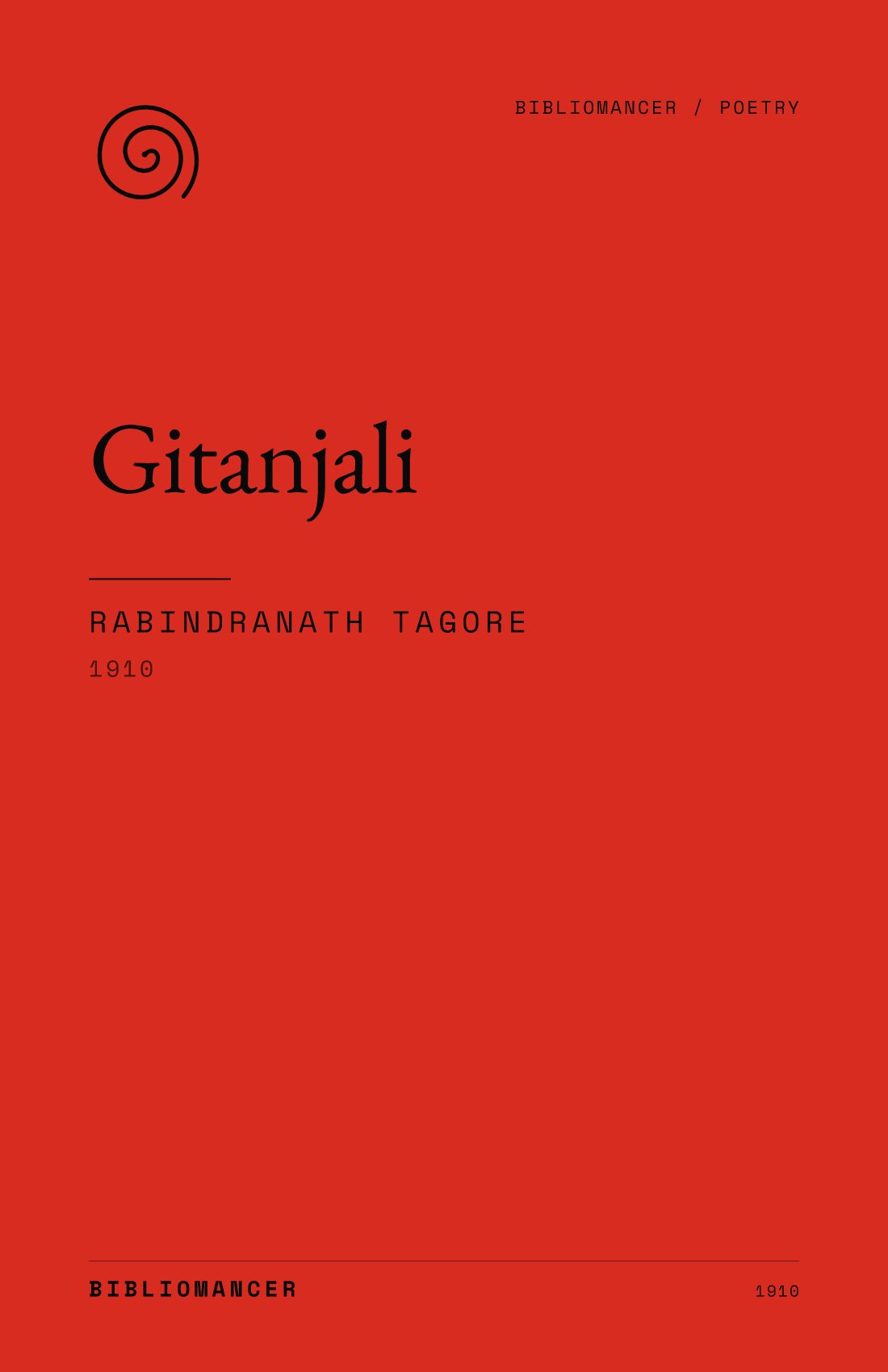
Gitanjali
Rabindranath Tagore · translated by Rabindranath Tagore
A sequence of devotional lyrics addressed to a divine "you" who is by turns lover, king, and stranger — songs of longing, surrender, and the presence of the sacred in ordinary daily life, translated by their own author from the Bengali collection that made his name.
Rabindranath Tagore published the original Gitanjali in Calcutta in 1910; this English volume of prose-poem translations, drawn from that book and several others of his, appeared in London in 1912 with an introduction by W. B. Yeats, who had met Tagore that same year and championed the poems to English readers. The following year, 1913, Tagore became the first Asian writer awarded the Nobel Prize in Literature, largely on the strength of this collection.
This Bibliomancer edition presents the complete text, together with Yeats's introduction.
Contents
New editions
Never lose your place.
This book is free to read in full, and stays that way. Leave an address: one click confirms it and opens a free account, so your progress and bookmarks sync across every device. You'll also hear when the next restored edition enters the archive. Terminate at any time.
Subjects
About this edition
The text is free of copyright. This edition was prepared from an authoritative digitisation, processed by Bibliomancer under its own review protocol; every automated correction is recorded in its transformation log. Rights assessed for CA, EU, GB, US.
Source mind
About the author
1861–1941 · Modern
Rabindranath Tagore (1861–1941) was born in Calcutta to one of Bengal's most prominent intellectual families, and began publishing poetry in Bengali as a teenager, going on to write across nearly every literary form — poetry, song, the novel, drama, the short story — alongside painting and composing music (he wrote what are now the national anthems of both India and Bangladesh). He managed his family's rural estates for much of his thirties and forties, an experience that shaped his lifelong commitment to village self-reliance and to the school he founded at Santiniketan, later expanded into Visva-Bharati University. Gitanjali ("Song Offerings"), a collection of devotional lyrics first published in Bengali in 1910, became widely known in the West only after Tagore's own English prose recasting of the poems appeared in 1912 with an introduction by W. B. Yeats; it won him the 1913 Nobel Prize in Literature, the first ever awarded to a non-European. He renounced the British knighthood he had accepted in 1919, in protest at the Jallianwala Bagh massacre of unarmed civilians in Amritsar, and remained an influential public voice on Indian nationalism and education until his death in Calcutta at seventy-nine.
Adjacent records