Fiction · 1850
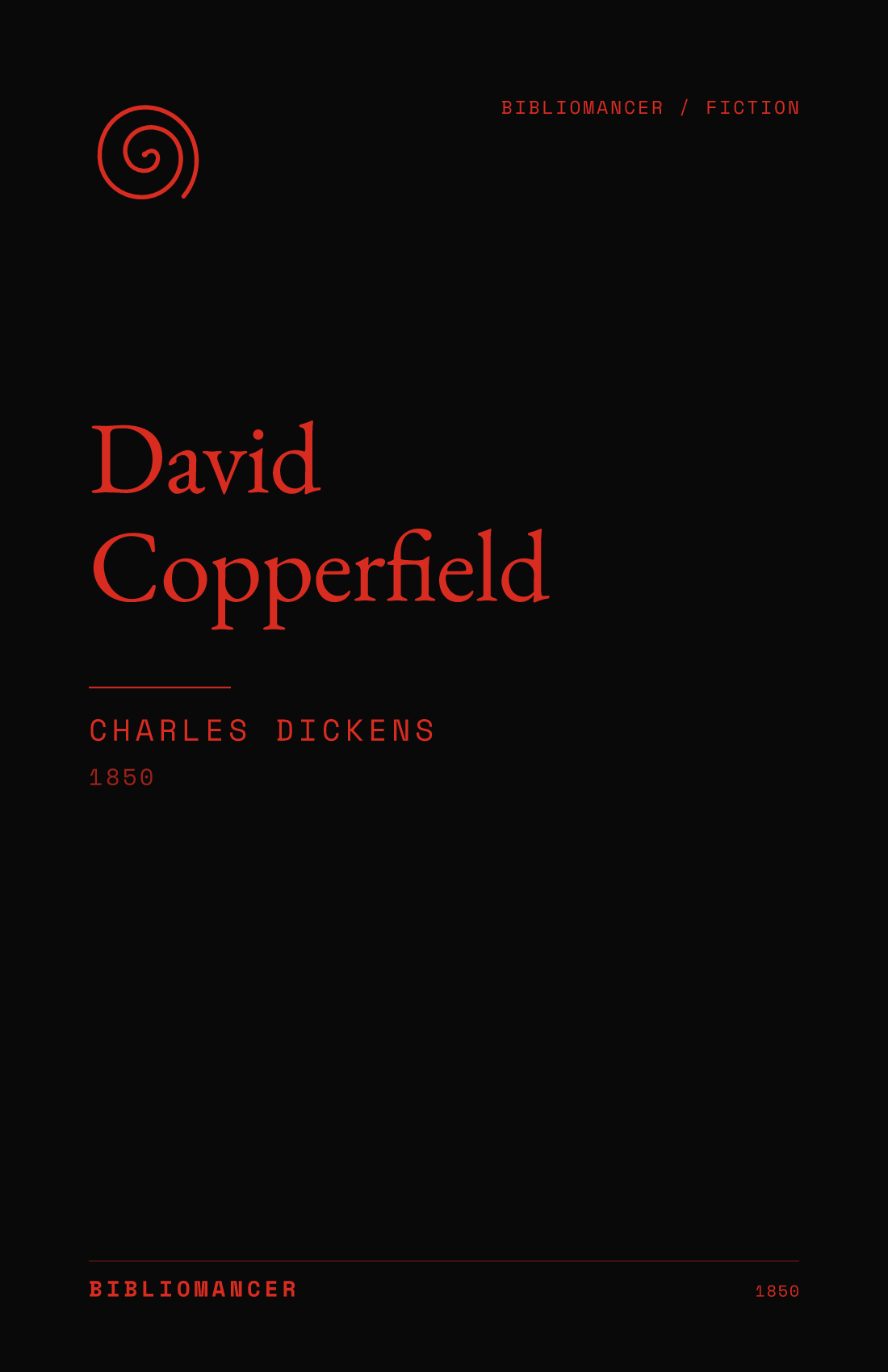
David Copperfield
David Copperfield tells its own story, from a birth attended by a great-aunt who leaves in disgust when he turns out to be a boy, through a cruel stepfather, a spell of child labour in a London warehouse, and a walk to Dover to throw himself on the mercy of an aunt he has never met — and Dickens narrates all of it in the first person, an unusual choice for him, as an adult remembering exactly how much a child understands and how much he doesn't. The cast around him is enormous even by Dickens' standards: the endlessly, cheerfully insolvent Mr. Micawber, the damp and unctuous Uriah Heep, the faithful Peggotty, the wrecked Little Em'ly — most of them drawn, by Dickens' own account, closer to life than anything else he wrote.
It ran in nineteen monthly parts from 1849 to 1850 before Bradbury and Evans published it complete that year. Dickens said late in life that of all his books he loved this one best, and the novel's own opening question — whether David will turn out to be the hero of his own life, or whether that station will be held by anybody else — is one he leaves the reader to answer.
Bibliomancer restores the 1850 text exactly as Dickens wrote it.
Contents
- Dedication
- Preface to 1850 Edition
- Preface to the Charles Dickens Edition
- Chapter 1 — I Am Born
- Chapter 2 — I Observe
- Chapter 3 — I Have a Change
- Chapter 4 — I Fall Into Disgrace
- Chapter 5 — I Am Sent Away from Home
- Chapter 6 — I Enlarge My Circle of Acquaintance
- Chapter 7 — My ‘First Half’ at Salem House
- Chapter 8 — My Holidays. Especially One Happy Afternoon
- Chapter 9 — I Have a Memorable Birthday
- Chapter 10 — I Become Neglected, and Am Provided for
- Chapter 11 — I Begin Life on My Own Account, and Don’t Like It
- Chapter 12 — Liking Life on My Own Account No Better, I Form a Great Resolution
- Chapter 13 — The Sequel of My Resolution
- Chapter 14 — My Aunt Makes Up Her Mind About Me
- Chapter 15 — I Make Another Beginning
- Chapter 16 — I Am a New Boy in More Senses Than One
- Chapter 17 — Somebody Turns Up
- Chapter 18 — A Retrospect
- Chapter 19 — I Look About Me, and Make a Discovery
- Chapter 20 — Steerforth’s Home
- Chapter 21 — Little Em’ly
- Chapter 22 — Some Old Scenes, and Some New People
- Chapter 23 — I Corroborate Mr. Dick, and Choose a Profession
- Chapter 24 — My First Dissipation
- Chapter 25 — Good and Bad Angels
- Chapter 26 — I Fall Into Captivity
- Chapter 27 — Tommy Traddles
- Chapter 28 — Mr. Micawber’s Gauntlet
- Chapter 29 — I Visit Steerforth at His Home, Again
- Chapter 30 — A Loss
- Chapter 31 — A Greater Loss
- Chapter 32 — The Beginning of a Long Journey
- Chapter 33 — Blissful
- Chapter 34 — My Aunt Astonishes Me
- Chapter 35 — Depression
- Chapter 36 — Enthusiasm
- Chapter 37 — A Little Cold Water
- Chapter 38 — A Dissolution of Partnership
- Chapter 39 — Wickfield and Heep
- Chapter 40 — The Wanderer
- Chapter 41 — Dora’s Aunts
- Chapter 42 — Mischief
- Chapter 43 — Another Retrospect
- Chapter 44 — Our Housekeeping
- Chapter 45 — Mr. Dick Fulfils My Aunt’s Predictions
- Chapter 46 — Intelligence
- Chapter 47 — Martha
- Chapter 48 — Domestic
- Chapter 49 — I Am Involved in Mystery
- Chapter 50 — Mr. Peggotty’s Dream Comes True
- Chapter 51 — The Beginning of a Longer Journey
- Chapter 52 — I Assist at an Explosion
- Chapter 53 — Another Retrospect
- Chapter 54 — Mr. Micawber’s Transactions
- Chapter 55 — Tempest
- Chapter 56 — The New Wound, and the Old
- Chapter 57 — The Emigrants
- Chapter 58 — Absence
- Chapter 59 — Return
- Chapter 60 — Agnes
- Chapter 61 — I Am Shown Two Interesting Penitents
- Chapter 62 — A Light Shines on My Way
- Chapter 63 — A Visitor
- Chapter 64 — A Last Retrospect
New editions
Never lose your place.
This book is free to read in full, and stays that way. Leave an address: one click confirms it and opens a free account, so your progress and bookmarks sync across every device. You'll also hear when the next restored edition enters the archive. Terminate at any time.
Subjects
About this edition
The text is free of copyright. This edition was prepared from an authoritative digitisation, processed by Bibliomancer under its own review protocol; every automated correction is recorded in its transformation log. Rights assessed for CA, EU, GB, US.
Source mind
About the author
1812–1870 · Victorian
Charles Dickens (1812–1870) was born at Portsmouth and worked as a child in a blacking factory while his father was imprisoned for debt — an experience he drew on for the rest of his life. A parliamentary reporter by twenty, he became the most popular novelist in English with The Pickwick Papers (1836–37) and never lost that place: Oliver Twist, A Christmas Carol (1843), David Copperfield, Bleak House, Little Dorrit, A Tale of Two Cities (1859) and Great Expectations (1861) followed. He died at Gad’s Hill, Kent.
Adjacent records