Fiction · 1899
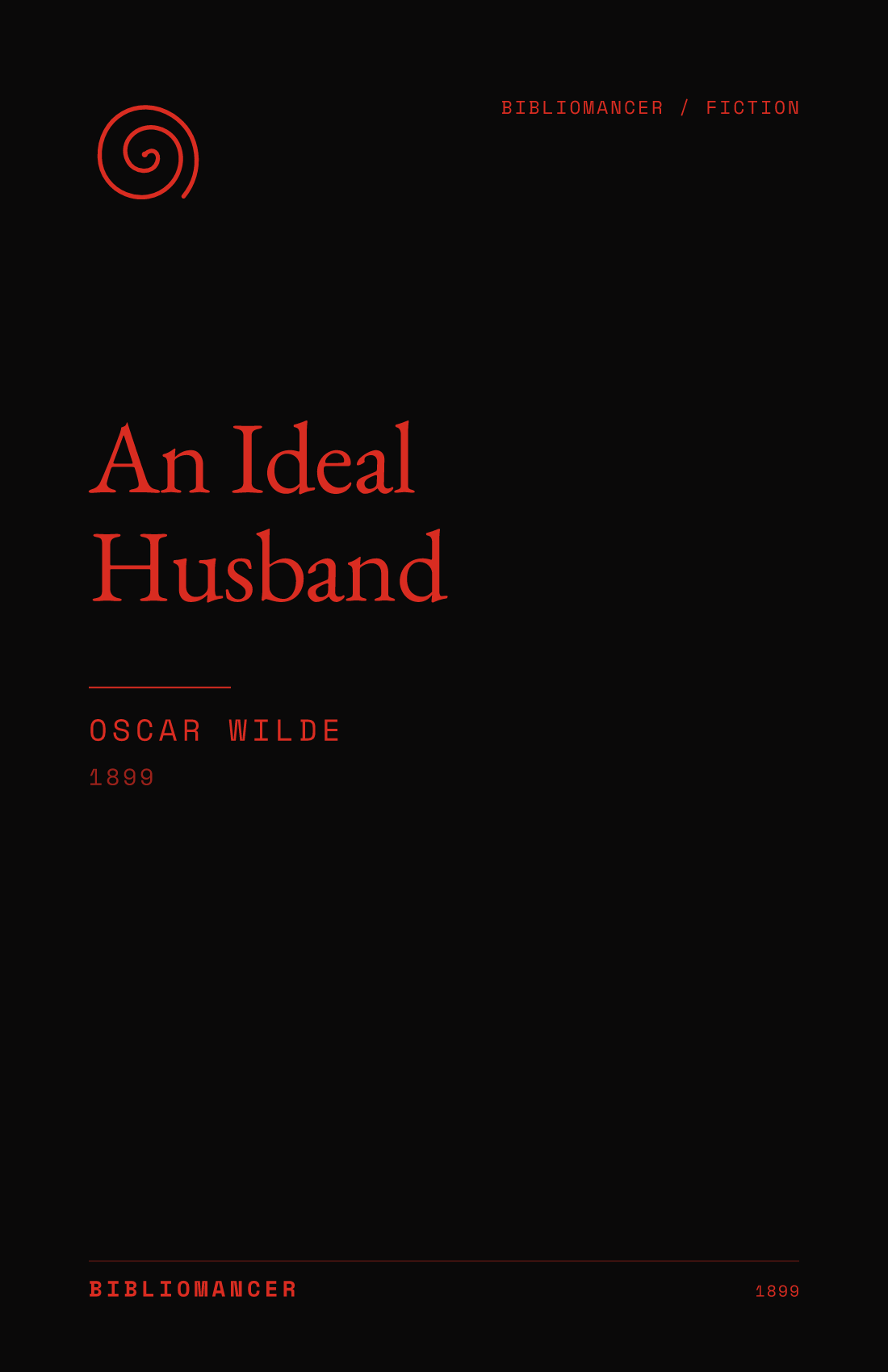
An Ideal Husband
Sir Robert Chiltern, a rising star of the Foreign Office married to a wife who reveres him as a paragon of public virtue, is confronted by the elegant, predatory Mrs. Cheveley with a letter proving that the fortune and career he built years ago rested on a single act of insider corruption. Blackmailed into supporting a fraudulent scheme in Parliament or seeing his ruin made public — and terrified above all of losing his wife's good opinion of him — Chiltern turns for help to his friend Lord Goring, whose idle wit conceals a shrewder moral sense than anyone around him credits. Wilde's comedy turns an ordinary blackmail plot into an argument about the impossible standard an "ideal" husband is expected to meet, and about how much mercy a marriage can survive.
An Ideal Husband was first performed at the Haymarket Theatre on 3 January 1895; Wilde corrected the proofs for its first publication in book form four years later, in 1899, brought out by Leonard Smithers after the scandal of Wilde's trials had driven off his earlier publishers.
This Bibliomancer edition presents the complete text, including Wilde's own prefatory notes on time, place and the persons of the play.
Contents
New editions
Never lose your place.
This book is free to read in full, and stays that way. Leave an address: one click confirms it and opens a free account, so your progress and bookmarks sync across every device. You'll also hear when the next restored edition enters the archive. Terminate at any time.
About this edition
The text is free of copyright. This edition was prepared from an authoritative digitisation, processed by Bibliomancer under its own review protocol; every automated correction is recorded in its transformation log. Rights assessed for CA, EU, GB, US.
Source mind
About the author
1854–1900 · Victorian
Oscar Wilde (1854–1900) was born in Dublin, studied at Trinity College and at Oxford, and became the most celebrated wit of late-Victorian London. The Happy Prince and Other Tales (1888), The Picture of Dorian Gray (1890–91), Lady Windermere’s Fan (1892), An Ideal Husband and The Importance of Being Earnest (both 1895) made his reputation. In 1895 he was convicted of gross indecency and served two years’ hard labour; De Profundis and The Ballad of Reading Gaol came out of the experience. He died in Paris.
Adjacent records